
6 min read
Forehead and Frown Line Botox: A Guide
How forehead botox works, why frown lines form, how brow drop risk is reduced and how long results last. A clear, honest guide from Istanbul.
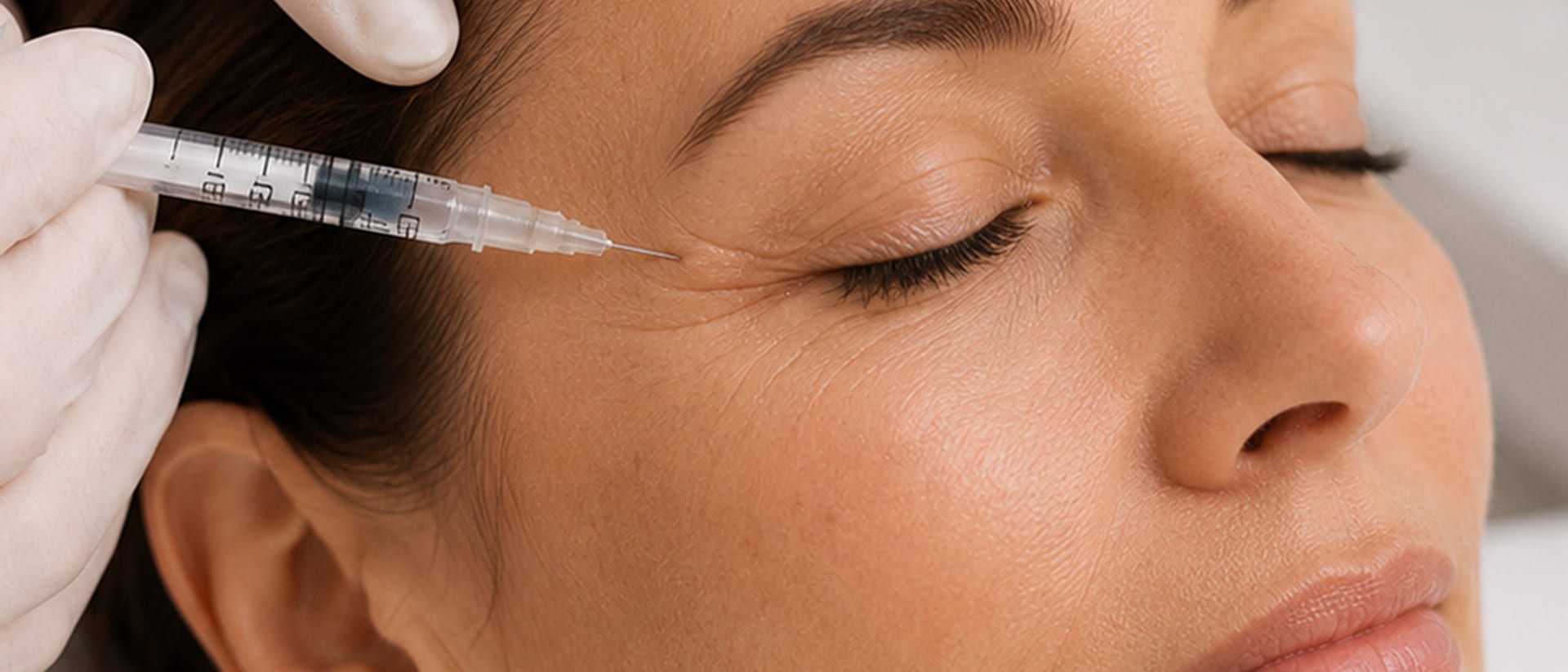
"I'm not angry, but my face says otherwise." That sentence comes up in consultations often. The two vertical lines between the brows and the horizontal bands across the forehead can make a relaxed face read as tense or tired. Forehead botox targets exactly that. Here we explain what dynamic lines are, how the muscles work, how dosing is decided, why brow drop happens, and how long results last.
What dynamic wrinkles actually are
Some facial lines only appear when you move. Raise your eyebrows and horizontal bands cross the forehead. Frown, and two vertical lines appear between your brows. These are dynamic wrinkles, and their source isn't the skin itself — it's the muscle underneath.
Repeat the same movement thousands of times over the years and the skin begins to hold the fold. As collagen and elastin support declines, the line stays visible even at rest. That's a static wrinkle.
The distinction matters:
- Botulinum toxin works primarily on dynamic lines by reducing muscle contraction.
- Deeper, established static lines often soften noticeably but may not disappear entirely.
- Very etched lines may also call for approaches aimed at skin quality.
So there is no single answer to "will my line go away completely?" How set-in a line has become can only be judged in person. For the general mechanism, our what is botox guide covers it.
The forehead and glabella muscles
These two areas can't be planned separately, because the muscles involved pull in opposite directions.
The forehead: the frontalis. A broad, fan-shaped sheet covering the forehead, and the only muscle that lifts the eyebrows. It also creates those horizontal lines when you raise them.
Between the brows: the glabellar complex. Several muscles work together here, and all of them pull the brow down:
- Corrugators: draw the brows inward and down — the main source of the two vertical frown lines.
- Procerus: sits at the bridge of the nose and creates the horizontal crease between the brows.
- Depressor supercilii: pulls the inner brow downward.
One lifter, several depressors. Silence the forehead entirely and you remove the only muscle holding the brow up, while the muscles pulling it down keep working.
Treatment and the logic behind dosing
The appointment is short. The area is cleaned, and small amounts of product are placed into the muscle with a very fine needle. Most people describe minimal discomfort and return to normal activities the same day.
The real work happens before the needle. Your doctor typically assesses:
- Muscle strength and movement pattern. You'll be asked to raise your brows, frown and squint. Strength varies widely, and men often have more muscle bulk here.
- Brow position and eyelid anatomy. If the brow already sits low, or there is excess upper eyelid skin, forehead dosing is planned far more conservatively.
- The character of the lines. Purely dynamic, or already etched? Symmetrical or not?
- Your goal. Movement significantly reduced, or simply softened?
Dose is not a fixed number. Units and injection points vary from person to person, and a diagram you found online does not describe your face. The general principle: relax the glabellar group more decisively while keeping the forehead balanced, with a safety margin above the brow line.
For a first treatment, the common recommendation is to start conservatively. At the two-week review, a point that needs a little more can be topped up; a dose that was too generous cannot be taken back. That logic matters most for anyone considering botox for the first time.
Keeping your expression natural: the brow drop question
The most common worry is a fair one: "Will my brows drop? Will I look frozen?"
Two different things can lower the brow:
- Brow ptosis (brow drop). Can happen when too much product is placed in the frontalis, particularly too close to the brow. The lifting force is reduced, the brow settles lower, and the upper lid can look heavy.
- Eyelid ptosis (droopy lid). Less common. It can occur if product spreads deeper from the glabellar area and affects the muscle that lifts the upper eyelid.
Both are temporary and resolve on their own as the effect wears off, though it can take several weeks. Injectors generally reduce the risk by:
- Keeping forehead dosing measured, with injection points a safe distance above the brow.
- Planning the forehead and glabella together rather than treating the forehead alone.
- Being more cautious in people with a naturally low brow or significant upper lid skin.
- Controlling injection depth and volume to limit spread.
A natural result isn't zero movement; it's less harshness with your expression intact. For most people the goal is to still be able to frown, just without carving a deep groove while doing it. We cover the common fears around this in does botox freeze your face.
How long results last
Nothing happens immediately. Softening usually becomes noticeable within 3-5 days, and the full result typically settles at around 10-14 days. A two-week review is therefore a sensible point for any small refinements.
Duration varies, but is generally reported as 3-4 months on average. Muscle strength, metabolism, intense exercise, the dose used and the area treated all play a part; people with strong muscles often see the effect fade sooner. Our guide on how long botox lasts has more detail.
When the effect fades, lines return to how they were; they do not come back worse. No doctor can guarantee a specific duration — these are averages.
Frequently asked questions
Will I still be able to raise my eyebrows? That's the aim. With measured dosing, brow-raising movement is generally preserved and only the deep creasing is reduced. Because completely silencing the frontalis can lower the brow, many injectors keep this area balanced. The right dose for you can only be determined in person.
Can I treat just the frown lines and skip the forehead? For some people, yes. But because the glabellar muscles pull the brow down, relaxing that group alone can cause the outer brow to sit slightly higher in certain faces. Whether the forehead is included depends on your muscle balance.
What happens if my brow does drop? It is temporary and usually resolves within a few weeks as the effect wears off. Stay in contact with your doctor during that period; small balancing adjustments are sometimes an option.
To find out whether your forehead and frown lines are still dynamic or already set in, and what a measured plan would look like for you, you're welcome to book a consultation in Istanbul.
This content is for informational purposes only and does not replace a medical consultation.