
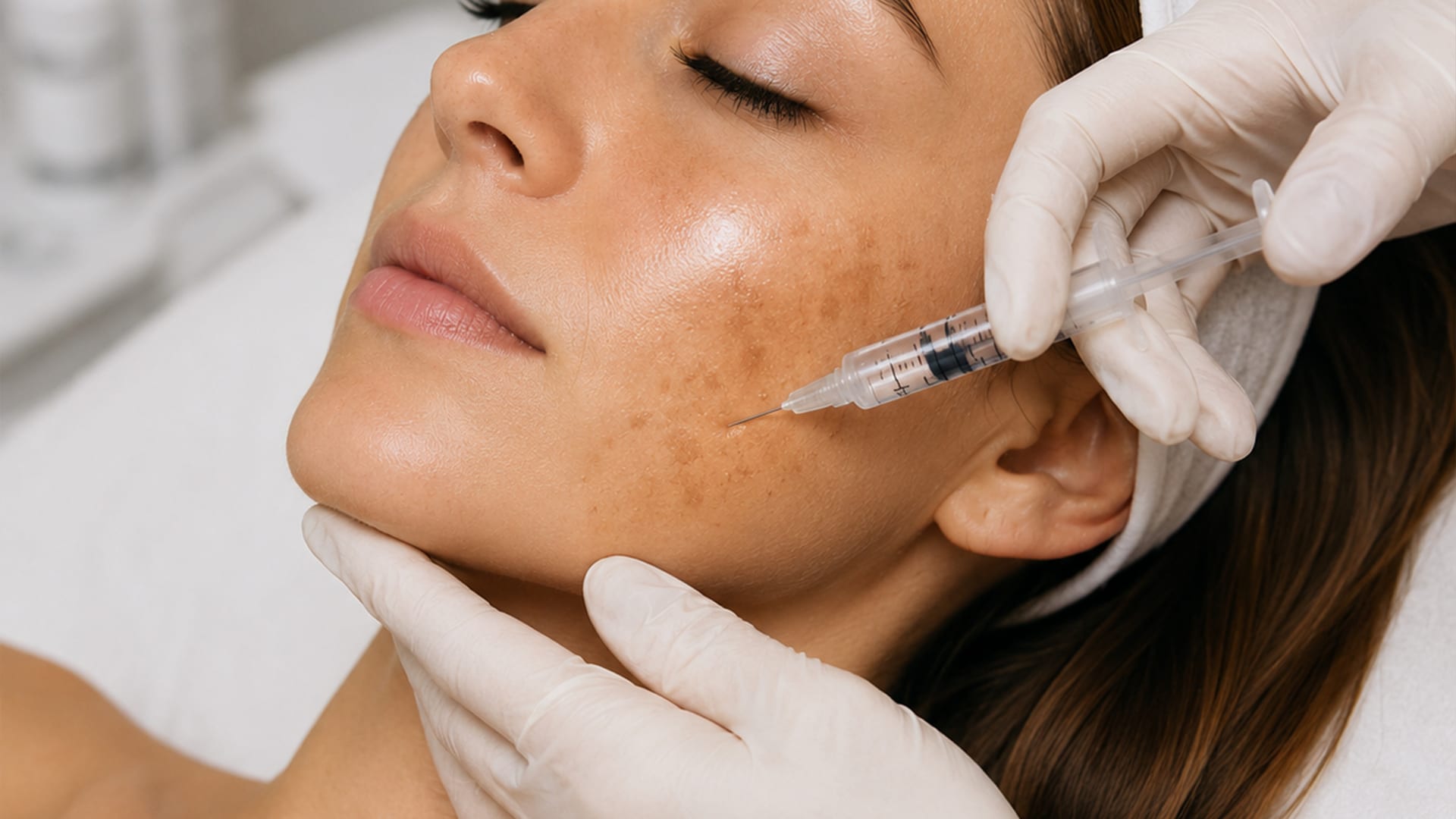
Who is it suitable for?
Considered for people describing dark patches on the face, the backs of the hands or the décolletage. The real work here is the diagnosis rather than the procedure: sun spots, melasma and post-inflammatory darkening behave differently and cannot be handled the same way.
How does it work?
The plan rests on two legs. The first is removing what drives the pigmentation — sun protection, and a review of any medication or hormonal factors that may be triggering it. The second is the treatment applied to the skin. Without the first, the second does not hold, and this is especially true in melasma.
How is it performed?
The type and depth of the pigmentation are assessed at examination, with a dermatological opinion where needed. A treatment plan and a home care routine are then built together. This is a followed-up process, not a single session. This type of treatment is planned according to a prior medical assessment.
What to watch for afterwards
Sunscreen is a required part of the process, not an optional one, and is used on overcast days too. Products that irritate the skin are avoided. Holding the result depends on keeping the protection up after treatment ends.
This treatment is not for everyone
Who should not have it?
A lesion that looks suspicious, has irregular borders, or is changing in colour or size is not a cosmetic matter; no treatment is carried out and the person is referred for dermatological assessment. Options are limited during pregnancy, and pregnancy-related melasma is usually reassessed after birth.
Frequently asked
About this treatment
Will the pigmentation clear completely?
The type decides. Superficial sun spots respond better, while conditions such as melasma are brought under control but may not disappear entirely. An approach that promises complete clearance is not being realistic.
Why is melasma handled differently from other pigmentation?
Melasma is hormonally driven and light-sensitive; as long as the trigger persists, treatment alone is not enough, and aggressive procedures can make it worse. The approach is therefore more cautious and weighted toward protection.
When do results show?
The change is gradual and reads over weeks. This is a followed-up plan rather than a single session, and it is adjusted at interim reviews where needed.
Will the pigmentation come back?
It can, unless the trigger is removed. Sun exposure is the most common one; hormonal factors and certain medications can also trigger it. Protection is therefore kept up after treatment ends.
Should I start in winter?
Starting when the sun is weak is an advantage, because the skin becomes more light-sensitive during treatment. As long as protection is maintained, though, the process can be planned at other times of year too; this is discussed at examination.
Wouldn't a pigmentation cream from the pharmacy be enough?
In some cases home care is an important part of the plan, but whether it is enough on its own depends on the type and depth of the pigmentation. The wrong product can also make things worse, particularly in melasma.
What should I do before the appointment?
Medicines and supplements that thin the blood — aspirin, ibuprofen-type painkillers, vitamin E, omega-3 — make bruising more likely. Tell us before your appointment if you take any; whether and when to pause them is your doctor's decision. Never stop a prescribed medicine on your own. If you have a history of cold sores, say so: an injection can trigger one.
Does it hurt? Is anaesthetic used?
Very fine needles are used, and a topical anaesthetic cream is applied beforehand where it helps. Most people describe a mild sting. Pain thresholds differ, so if you are uncomfortable during the procedure just say so — it can be paused and more can be done.
Can it be done during pregnancy or breastfeeding?
Aesthetic injections are not advised during pregnancy or breastfeeding. There is not enough safety data for these periods, so they are avoided. Tell us beforehand if you are or might be pregnant, or are breastfeeding.
Which products are used?
Only licensed, single-use, sterile products. If you would like to know the name and contents of the product being used, that is shared at the consultation, and the packaging is opened in front of you.
Why is there no price on the site?
Türkiye's health advertising rules prohibit clinics from publishing prices or promotional offers. Beyond that, the amount used and the number of sessions vary from person to person, so a single figure would be misleading. Your own figure is given directly after the consultation.
Can another treatment be done in the same session?
Some treatments can be planned together in one session; others need to be spaced apart. That is decided after the face is assessed as a whole — the aim is to get the order right, not to add procedures.
This page is for general information and is not medical advice. Treatment decisions follow a medical examination, and results vary between individuals.