6 min read
Crow's Feet Botox Explained
Crows feet botox explained: why lines form around the eyes, how treatment works, and whether your smile still looks natural afterward.
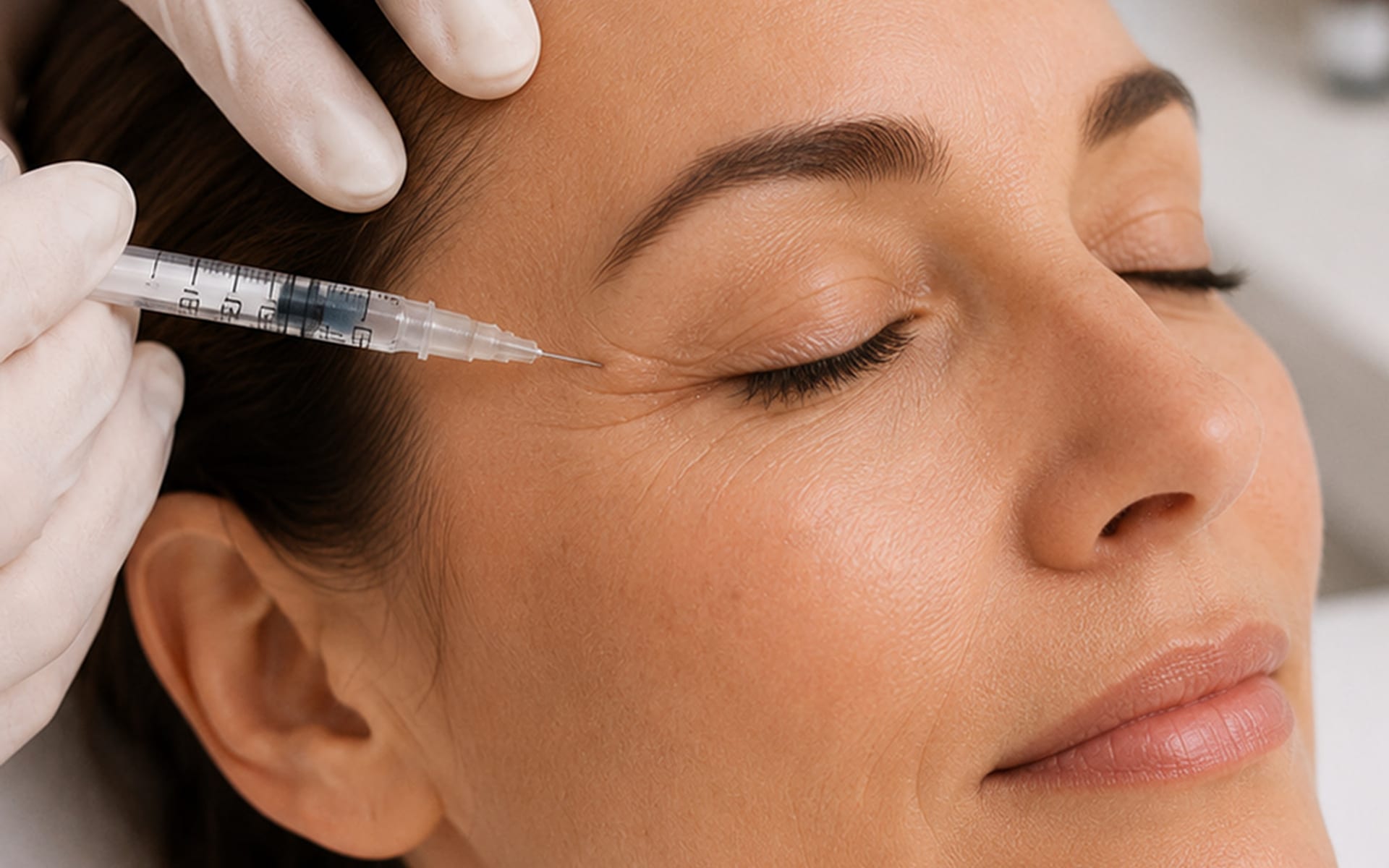
Most people notice them in a photo rather than a mirror: fine lines fanning out from the corners of the eyes, still visible after the smile has faded. Crows feet botox is one of the most commonly requested treatments for exactly this. This guide covers why the lines form, what makes the skin around the eye different, how treatment is performed, whether your smile still looks like yours, and what it pairs with.
Why crow's feet form
The muscle that circles each eye contracts every time you smile, squint, or focus on a screen, and the skin above it folds with each contraction. In younger skin that fold springs back completely. Over time the collagen and elastin network that allows this recoil thins out, and the fold stops disappearing entirely.
This is why clinicians distinguish two stages of the same line. A dynamic line appears only during movement. A static line remains etched at rest. Most people arrive somewhere in between.
Several factors influence how quickly this progresses:
- Cumulative sun exposure and UV-driven photoaging
- Smoking
- Habitual squinting, including from uncorrected vision
- Genetics and skin type
- Skin quality, hydration, and sleep
Crow's feet are not a flaw; they are the natural result of an expressive face. The goal of treatment is not to erase that expression, but to soften the line and slow how quickly it deepens.
The skin around the eye is thin
The periorbital area has some of the thinnest skin on the body. There is little fat padding beneath it, the underlying support is delicate, and the muscle runs close to the surface. Two things follow.
First, lines show up here earlier and more visibly than elsewhere on the face. Second, the area demands a more conservative technique than, for example, forehead and frown line treatment. Injection points that drift too close to the eyelid or the cheek can affect muscles that were never meant to be relaxed, which is how unwanted effects such as a temporary heavy eyelid occur.
There is therefore no universal protocol for crow's feet. Muscle strength, line direction, smile pattern, and eyelid anatomy all vary. A suitable plan can only come out of an in-person assessment.
How the treatment works
Botox uses very small doses of botulinum toxin to temporarily reduce the contraction strength of a targeted muscle. For crow's feet, the sequence is typically:
- Assessment. You smile and squint so the physician can see how much of the line is dynamic and how much has become static.
- Mapping. A few points are marked lateral to the eye, a safe distance from the bony orbital rim.
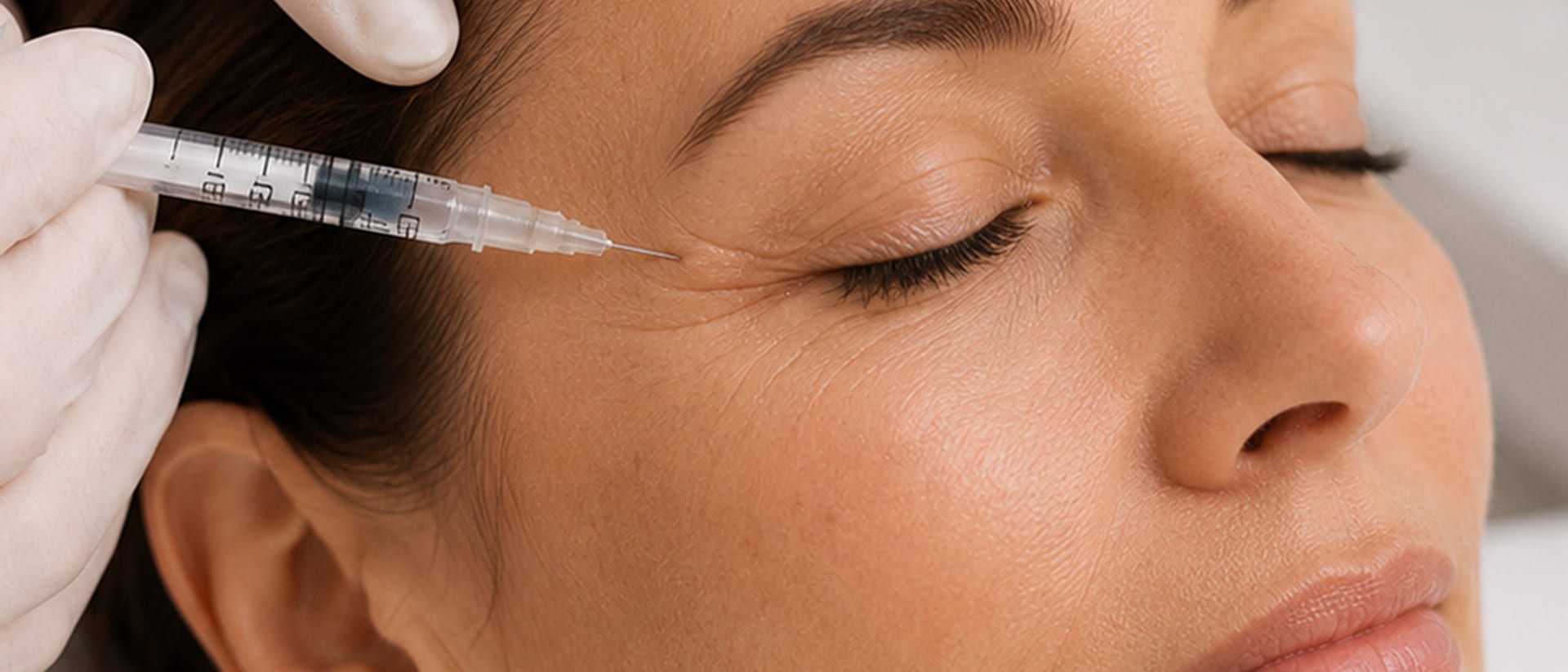
- Injection. Fine needles deliver small, superficial doses, usually in a few minutes.
- Aftercare. You can return to your day immediately. Common advice: avoid rubbing the area, bending forward for a few hours, and heavy exercise that day.
Onset generally begins within 3 to 7 days and settles by around two weeks. Results last an average of 3 to 4 months, varying with muscle strength, metabolism, and expression habits. Our guide on how long botox lasts covers what shifts that range.
Mild redness, small bumps, or occasional bruising can occur and usually resolve on their own. No physician can guarantee a specific outcome; individual response differs.
Will your smile still look natural?
This is the question almost everyone asks. With appropriate dosing and correct placement, the aim is not to remove the smile but to reduce how sharply the skin folds when you smile. The expression stays; the crease softens. A few principles keep it that way:
- Conservative dosing. Too much product flattens the expression and interrupts the way a genuine smile spreads across the face.
- Careful placement. Injections stay away from the cheek and the eyelid margin.
- A staged approach. Start measured, add a small touch-up at the two-week review if needed. Adding is always possible; removing is not.
- The whole face. Softening only the crow's feet while ignoring the upper face can leave the expression unbalanced.
One honest limitation: deep static lines that took years to form are not fully erased by botox. It reduces the movement that created the line; it does not repair the structural change in the skin itself. Setting that expectation correctly is what makes people happy with the outcome.
Combining with skin quality treatments
Results around the eyes usually come from matching the treatment to the layer of the problem, rather than asking one method to do everything. Botox addresses movement. The thinness, dryness, and texture of the skin are a separate question.
- Skin quality support. Skin boosters, which focus on hydration and collagen support, may help thin skin look plumper and smoother.
- Regenerative approaches. Some methods aimed at skin renewal can be complementary here. Effects vary between individuals, and parts of this field are still developing and under research.
- Sun protection. It replaces nothing, but it is one of the habits that most visibly affects how long a result holds.
Combining does not automatically mean more treatments. For some people a measured botox session alone is enough; for others, skin quality is the priority and comes first. Sequence and timing are decided at consultation.
Frequently asked questions
Will crow's feet botox cause a droopy eyelid? It is not an expected outcome of a correctly planned treatment. Injections are placed lateral to the eye at a safe distance from the orbital rim. The rare cases of temporary eyelid heaviness are generally linked to misplaced points or excessive dosing, and they are not permanent; they resolve as the effect wears off. This is why the injector's knowledge of anatomy matters more than any product choice.
At what age should I start? Age matters less than what the assessment shows. In some people the lines appear only on smiling and monitoring is enough. In others, a trace already remains at rest. Lines are generally easier to manage before they become fully static, but the right timing is an individual decision made in person.
Will my lines look worse once it wears off? No. As the effect fades, the muscle regains its strength and the lines gradually return to how they looked before treatment. They do not come back deeper. The sense that things "got worse" usually comes from having grown used to the softened look.
If you are in Istanbul or planning a visit, a consultation in Yeşilköy/Bakırköy can tell you whether your lines are dynamic or static and what measure would suit your face.
This content is for informational purposes only and does not replace a medical consultation.