
6 min read
10 Botox Myths Debunked
The most common Botox myths, examined honestly: is it toxic, is it addictive, will it freeze your face, and does it build up in your body?
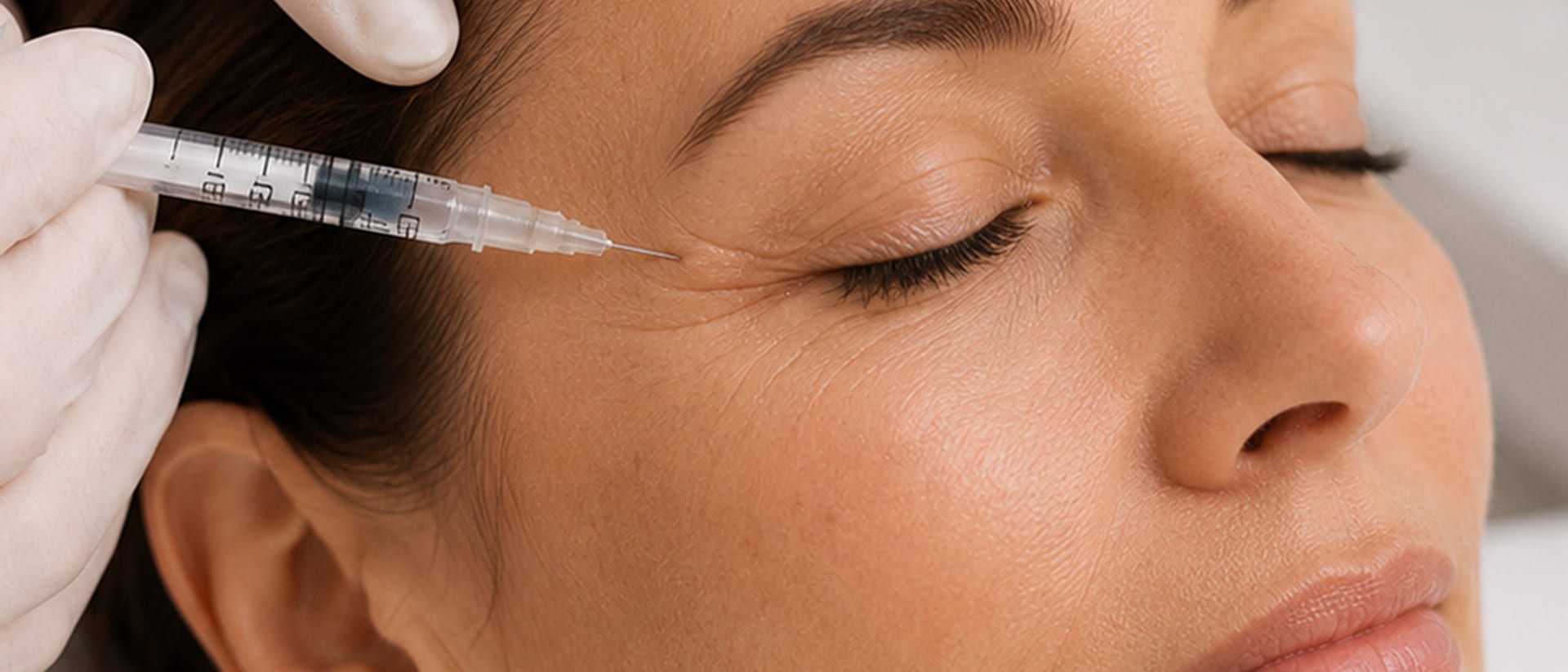
Botox is one of the most studied treatments in medical aesthetics and also one of the most misunderstood. Most people arrive at a consultation carrying a fear rather than a question: that it is a poison, that it is addictive, that their face will stop moving. This guide walks through ten of the most persistent Botox myths and explains, plainly and without overselling, what the medical evidence actually supports.
Myths about safety and how Botox works
1. "Botox is a poison that will damage your body." Botulinum toxin is a bacterial protein, and in large uncontrolled amounts it can cause illness. That is where the myth begins and also where it ends. What is used in a clinic is a purified, standardized medicine given in extremely small doses that stay confined to the treated muscle, far below any threshold associated with systemic harm. It has been used in medicine, including neurology and ophthalmology, for decades. For the mechanism explained step by step, see what is Botox.
2. "You'll walk out of the clinic looking different." You won't, and that is normal. Botox works by temporarily reducing the signal between nerve and muscle, which takes time to develop. Most people notice something within three to seven days, and the result generally settles around day ten to fourteen. This matters if you are traveling: planning treatment a day before a wedding or a flight home rarely works out well. Allow the result time to appear before judging it.
3. "Botox erases every wrinkle on your face." It does not, because not all lines are the same. Botox addresses dynamic lines, the ones created by repeated muscle movement, such as frown lines, forehead lines and crow's feet. Static lines, visible even when your face is completely at rest, are more about collagen loss and skin quality, and they usually call for fillers, skin rejuvenation or regenerative approaches instead. Which category your lines fall into can only be judged in person.
4. "It's painful and you need days of downtime." Botox is delivered through very fine needles and the injections themselves usually take only a few minutes. Most people describe a brief pinch. Small red marks, tiny raised bumps or an occasional bruise at the injection points are possible and typically settle quickly. That said, every injectable carries some risk, and how your body responds is individual, which is why a proper medical history is never a formality.
Myths about addiction and build-up
5. "Botox is addictive." There is no physiological mechanism by which Botox creates dependence. Your body does not come to need it, and stopping produces no withdrawal. What people call addiction is usually a preference: someone likes how they look, the effect fades, and they choose to repeat it. That is a decision, not a chemical hold.
6. "Once you start, you can't stop — quitting makes you look worse." No. As the effect wears off, the muscle gradually regains its full movement and the lines return to roughly where they were before. It can feel worse, but that is a comparison effect: after months of seeing a smooth forehead, its return looks more pronounced than it is, and normal aging has continued in the meantime. Stopping Botox does not damage your skin or accelerate aging.
7. "It accumulates in your body and eventually becomes permanent." Botox does not accumulate. The protein is broken down over time and muscle function returns. The effect typically lasts three to six months on average, varying with dose, treated area, muscle strength and individual metabolism — more on that in how long does Botox last. The genuine consideration is not build-up but over-frequent treatment: very frequent, high-dose sessions have been associated in some people with reduced response over time. Planned intervals, rather than topping up whenever you feel like it, are the sensible approach.
Myths about looking natural and who Botox is for
8. "Botox always freezes your face." A frozen look comes from dose and placement decisions, not from the treatment itself. The goal is to soften excessive muscle activity, not to abolish expression, and a well-planned result should still let you smile, frown and raise your eyebrows. We cover this in detail in does Botox freeze your face. It is worth saying clearly that no physician can guarantee exactly how a face will respond; muscle strength and sensitivity differ from person to person.
9. "Botox is only for women, and only after a certain age." Neither holds up. Botox for men is increasingly common, and because male facial muscles tend to be stronger, dosing and placement are planned differently, usually to soften a permanently stern expression rather than to smooth everything (Botox for men). As for age, there is no magic number: the decision rests on the state of your expression lines and your goals, not your birth year. The idea that early, low-dose treatment can delay lines from setting in is widely held, but it is not a prescription that suits everyone and it does not justify unnecessary treatment.
10. "Botox is just a wrinkle treatment." Its uses extend well beyond lines. It is also used for excessive sweating, for jaw clenching and a widened lower face caused by an overactive masseter muscle, and for an excessively gummy smile, among other indications. Each involves different dosing, technique and expectations, so "I had Botox" describes a family of treatments rather than one procedure.
Frequently asked questions
Why are Botox myths so persistent? Most come from generalizing poor results. When you see an unnatural face online, you are looking at a dosing and planning decision, not at what the treatment inevitably does. Overdone examples are simply far more visible than well-judged ones.
What happens if I regret it? Botox is temporary. If you dislike the result, the effect fades on its own over the following months and muscle movement returns fully. It is not an irreversible decision — though that is a reassurance, not a reason to skip a proper assessment beforehand.
Can anyone have Botox? No. It is avoided during pregnancy and breastfeeding, in certain neuromuscular conditions, where there is an active infection at the treatment site, and in people with a known allergy to the product. Suitability is individual and can only be established through a medical consultation.
If you would like to discuss what is realistic for your face rather than what the internet says, you are welcome to book a consultation at the clinic in Istanbul.
This content is for informational purposes only and does not replace a medical consultation.