6 min read
What Is Baby Botox / Micro Botox?
Baby Botox explained: how micro-dosing differs from standard Botox, who it suits, what it can realistically do, and where it falls short.

Most people who ask about baby Botox are not asking for less. They are asking for less obvious. The concern is almost always the same: the lines bother them, but a frozen forehead bothers them more. Baby Botox, also called micro Botox, grew out of that tension. Here is what it actually is, how it differs from a standard treatment, who it tends to suit, and where its limits sit.
The micro-dose idea
Baby Botox is not a different product or a different brand. The substance is the same neurotoxin used in a standard Botox treatment: it temporarily reduces muscle contraction. What changes is the dosing strategy, not the drug.
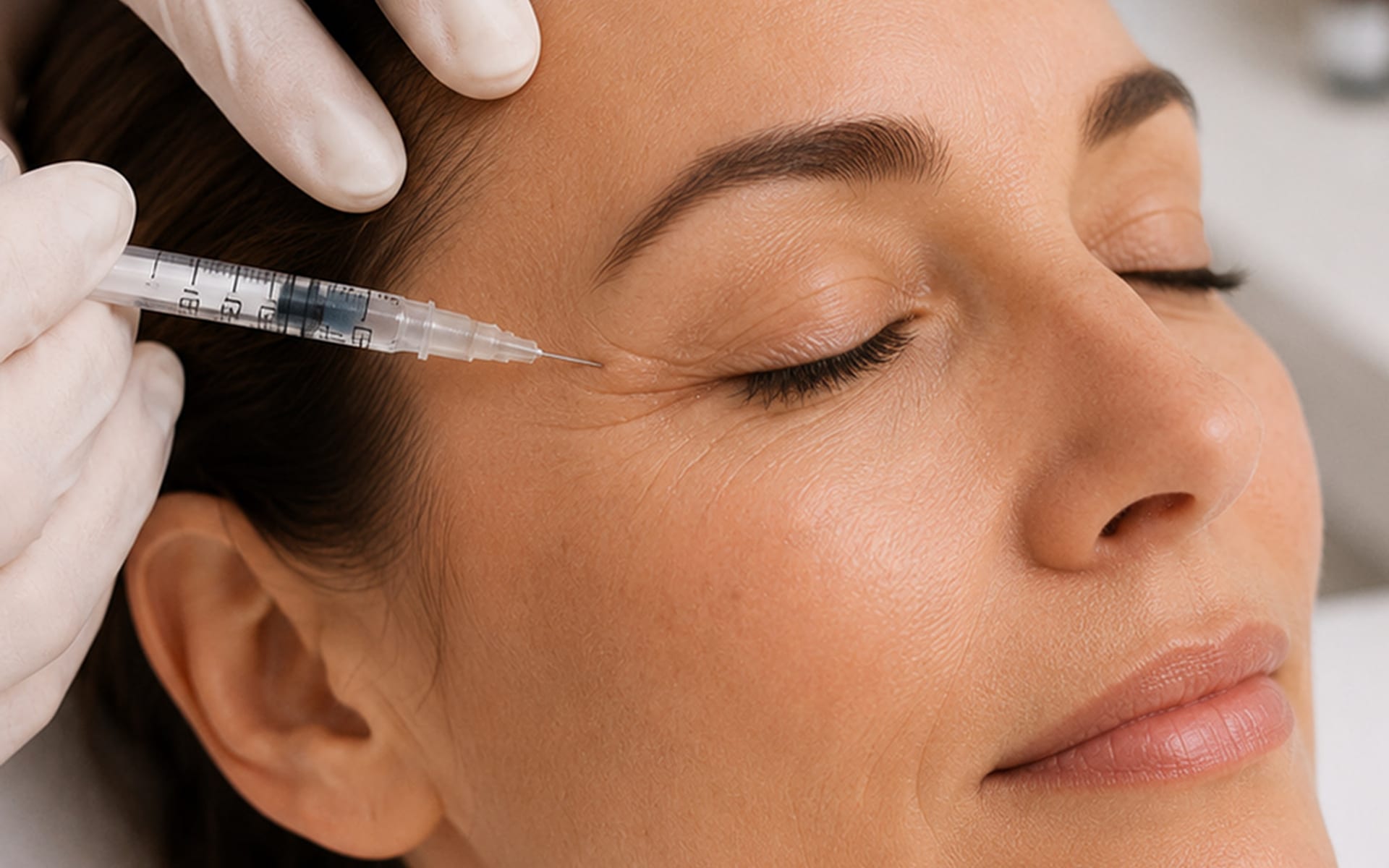
In a conventional treatment, a concentrated dose is placed into a muscle and that muscle's movement drops noticeably. In micro-dosing, a lower total dose is divided across more injection points, often placed more superficially. The goal is not to switch the muscle off. It is to turn its volume down.
In practice that means:
- Expression softens rather than disappearing.
- Lines become shallower rather than erased.
- The result usually reads as "rested," not "treated."
- If it is not enough, more can be added later. If too much is given, only time undoes it.
That last point is the real argument for micro-dosing. Adding is easy. Subtracting is not.
How it differs from standard Botox
The two are not rivals. They are two settings on the same instrument, and the right setting depends on how strong the muscle is and how established the line already is.
- Dose. Total units are typically lower. How much lower is individual; there is no standard "baby Botox dose."
- Injection points. The dose is spread across more points, distributing the effect more evenly and more gently.
- Depth. Placement can be more superficial, targeting fibers closer to the skin rather than the full muscle body.
- Goal. Standard dosing aims to reduce the line clearly. Micro-dosing aims to soften it while protecting expression.
- Duration. A lower dose generally means a shorter effect.
So baby Botox is not "safer Botox." It is a less interventionist setting. Safety depends far more on the injector's anatomical knowledge and on appropriate patient selection than on the number of units.
Who it tends to suit
Micro-dosing comes up most often in these situations:
- Younger patients in the early stage. Lines that appear only with movement, with smooth skin at rest. The aim is not to correct existing depth but to try to slow a line from becoming permanent. That preventive logic is reasonable, but no physician can promise a line will never form.
- People considering treatment for the first time. Starting low is a sensible way to learn how the result feels on your own face. If you are weighing up a first Botox treatment, building up gradually is usually more comfortable than a full dose.
- People who rely on expression professionally. On camera or on stage, losing expression can be a bigger problem than the line itself.
- Anyone who felt a previous treatment was "too much." If a standard dose felt heavy, a lighter setting next time is a rational adjustment.
It is a poorer fit for deep lines that stay visible when the face is still. Treatment is also not appropriate during pregnancy or breastfeeding, with certain neuromuscular conditions, or with an active infection in the area. That assessment belongs in a consultation, not a search result.
Why natural expression sits at the center
People are not afraid of the result. They are afraid of the result being noticed. And that fear is well-founded: an over-treated forehead stands out not because it is smooth, but because it does not move. A face that looks frozen is usually a problem of balance rather than of substance — which is the heart of the whole does Botox freeze your face question.
The measure of a natural result is simple. When you smile, the smile should reach your face. When you are surprised, it should show. Baby Botox is a deliberate choice to protect that measure.
There is a trade-off, and it should be said plainly. Less intervention means a less dramatic result. Some patients find that is exactly what they wanted. Others come back and say it did not do enough. Both reactions are legitimate. What matters is that the expectation was discussed before the needle, not after.
The limits
Knowing what baby Botox is not is as useful as knowing what it is.
- It does not lift sagging. A neurotoxin affects muscle movement. It does not correct skin laxity, volume loss, or descent caused by gravity.
- It does not change skin quality. Pores, texture, pigmentation, and dullness are a different conversation.
- It is limited on deep static lines. If a line is there when your face is at rest, micro-dosing usually will not remove it.
- It is not permanent. The effect is temporary and, at a lower dose, often fades earlier. How long Botox lasts varies with muscle strength, metabolism, and the individual.
- It is not risk-free. A lower dose may reduce risk, but it does not eliminate it. Bruising, transient headache and, less commonly, asymmetry or eyelid droop are possible at any dose.
The broadest limit: no physician can guarantee an outcome. Muscle strength, skin thickness, how old the line is, and how your body responds to the product are all individual. That is why the decision is made through examination, not through photographs.
Frequently asked questions
Does baby Botox prevent lines in younger people? Promising prevention would be dishonest. Repeated muscle contraction gradually etches a line into the skin, so reducing that contraction may slow the process. Genetics, sun exposure, and lifestyle are also in the equation. "May slow it down" is a fair claim. "Prevents it" is not.
How long does the effect last? A lower dose generally means a shorter duration. Standard treatments are often described as lasting 4-6 months on average, and micro-dosing can be shorter. Variation between individuals is substantial; people with strong muscles often see it wear off sooner.
What happens if it is not enough? It is usually reviewed at a follow-up appointment, and more can be added if needed. That is the advantage of starting low: topping up is possible, while removing an excess is not.
If you would like to know whether micro-dosing is a sensible setting for your lines, you are welcome to book a consultation at the clinic in Istanbul.
This content is for informational purposes only and does not replace a medical consultation.