6 min read
Does Botox Freeze Your Face?
Does Botox freeze your face? Learn why a frozen look happens, how correct dosing preserves expression, and why the effect always wears off.
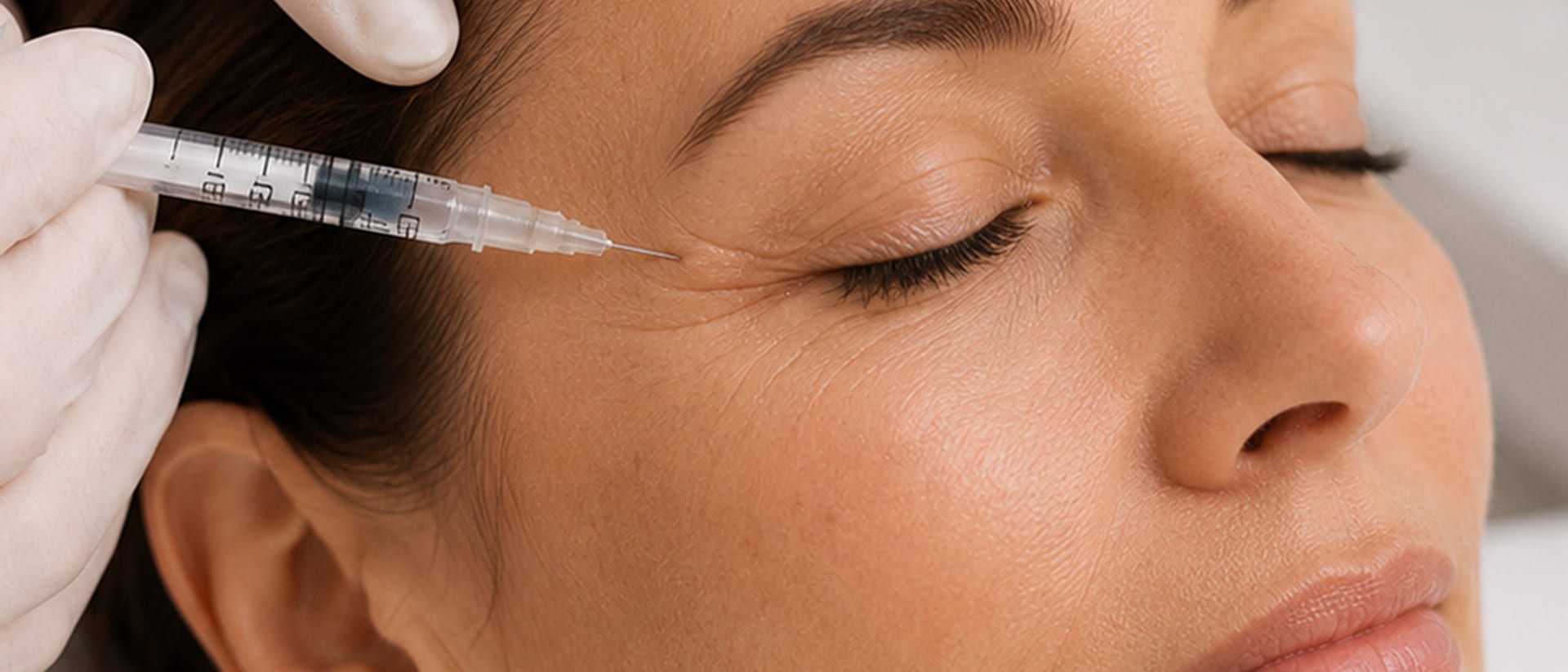
It is the question almost everyone asks before their first appointment: does Botox freeze your face? The worry is understandable. We have all seen motionless foreheads and smiles that do not quite reach the eyes. But a frozen look is not what Botox does by default — it is what happens when Botox is done poorly. Below we explain where that look comes from, how careful dosing keeps your expressions intact, and why the effect is never permanent.
Why a "frozen" look happens
Botox works in one way only: it temporarily reduces the contraction strength of the muscle it is injected into. So the problem is never the product itself. It is how much went where. Two mistakes account for nearly every frozen face.
Too much product. Softening a muscle and silencing it completely are not the same thing. When more units than necessary go into the forehead, the forehead stops moving altogether. The small natural movements — raising an eyebrow, looking surprised, the slight crinkle at the eyes when you laugh — disappear. The result does not look younger. It looks blank.
The wrong injection point. Facial muscles work as a balanced system, with muscles that lift the brow sitting right next to muscles that pull it down. A point chosen incorrectly, or placed at the wrong depth, upsets that balance. Brows can sit too low, one side can settle differently from the other, or the outer brow can peak in an unnatural way. None of this is inherent to the treatment. It is a planning problem.
There is a third, quieter cause: stacking. Treatments repeated too soon build on top of a still-active dose and gradually produce a face that barely moves.
Correct dosing preserves expression
A good treatment plan does not aim to eliminate movement. It aims to calm the overactive muscle that is etching a line into your skin while leaving the rest of your face to do what it has always done. In practice that means:
- Dosing to your muscle, not to a chart. A strong, thick forehead muscle and a delicate one do not respond to the same number of units. There is no single recipe that fits everyone.
- Treating the area as part of a whole. Relaxing the forehead alone can leave the brows feeling heavy. The surrounding muscles have to be accounted for.
- Starting conservatively. Adding more is easy. Removing it is not. Beginning with a measured dose and topping up at a two-week review, if needed, is a sensible route.
- Lighter-dose approaches. Techniques such as baby Botox use smaller units placed more superficially, with the specific goal of preserving movement. Whether it suits you is decided at an examination, not online.
With a well-planned result, your face still moves — that movement simply stops carving a deep line. The reaction you are looking for is not "what have you had done?" but "you look rested." That said, outcomes vary from person to person, and no physician can guarantee a specific look.
Why the injector matters more than the product
From the outside, Botox looks like a few quick injections. The difficult part is not the needle — it is everything decided before it: which muscle, which point, which depth, how many units.
An experienced physician assesses your face in motion first. You will be asked to raise your brows, frown, and squint, because how your muscles actually work matters as much as the lines they leave behind. If you have a slight natural brow asymmetry — most people do — the plan has to account for it, or the treatment can make it more obvious.
This is also a medical procedure. Product authenticity, storage, dilution, and a sterile setting all affect both the result and your safety, so Botox belongs in a clinic and in a physician's hands. If you are travelling to Istanbul for treatment, allow enough time for a proper consultation rather than booking a same-day appointment on arrival. Your medications and medical history are part of the decision too. For the claims that circulate online, our piece on Botox myths may help.
It wears off — and so does a mistake
Here is the reassuring part: the effect of Botox is temporary. The muscle gradually regains its nerve signal, and movement returns on its own. On average, results generally last around 3 to 6 months, though this varies with metabolism, muscle strength, the area treated, and the dose used. We cover this in more detail in how long does Botox last.
That means a frozen look caused by overtreatment is not permanent either. Unlike hyaluronic acid fillers, there is no agent that reverses it instantly — the honest answer is that you wait. In the meantime:
- Rushing into corrective injections usually complicates the picture rather than fixing it.
- For some asymmetries, a very small amount on the opposite side can restore balance. Only your physician can make that call.
- Movement does not come back all at once. It returns gradually, over weeks.
The fact that Botox fades is exactly what makes it a low-commitment option: an outcome you dislike is not one you live with forever. For the basics of how the treatment works, see what is Botox.
Frequently asked questions
Will I still be able to smile normally? Yes. In a well-planned treatment, smiling, laughing, and everyday expression are preserved. The goal is to soften the excessive contraction that creates a line, not to stop the face from moving. The right dose and injection points differ from person to person, which is why an in-person assessment is necessary.
If my face does look frozen, can it be reversed? There is no agent that removes the effect immediately. However, Botox is temporary and the effect generally fades on its own within roughly 3 to 6 months. Rather than seeking more injections in a panic, speak with your physician so the situation can be assessed properly.
Is a very low dose pointless, then? Under-dosing can produce a weaker effect or one that fades sooner than expected. The right dose is not the smallest or the largest — it is the one that matches your muscle anatomy. Starting conservatively and topping up at a review appointment is a common, sensible approach.
If you would like to discuss a dosing plan that keeps your expressions intact, you are welcome to book a consultation at our clinic in Yeşilköy/Bakırköy, Istanbul.
This content is for informational purposes only and does not replace a medical consultation.